Blog

7 Productivity Bottlenecks in Companies: How to Fix Leadership and Team Performance Issues

7 Productivity Bottlenecks in Companies: How to Fix Leadership and Team Performance Issues

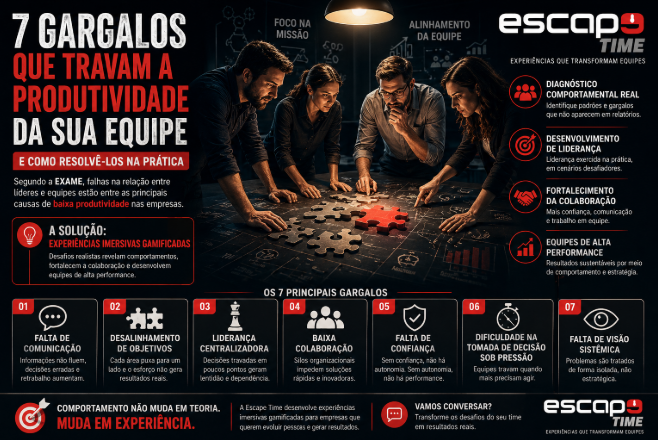
Low productivity in companies is rarely just a matter of processes or technology. In most cases, the main bottlenecks lie in the relationship between leaders and teams. According to an analysis published by Exame, issues such as poor communication, misaligned goals, and lack of collaboration are among the top factors impacting organizational performance.

Strategic HR: how to turn the people function into a driver of organizational performance

Strategic HR: how to turn the people function into a driver of organizational performance

Discover how strategic HR has evolved from an operational function to becoming essential for business growth. Learn how to generate tangible results through people management.
Why Designing an Escape Room Is More Like Producing a Netflix Series Than You Think

Why Designing an Escape Room Is More Like Producing a Netflix Series Than You Think

At first glance, an escape room might seem like just a collection of puzzles, locks, and logical challenges. But that’s a superficial view. In reality, creating a high-quality immersive experience is far closer to producing a Netflix series than designing a traditional game. And understanding this difference is what separates forgettable experiences from truly memorable ones.
The End of Interruption Marketing: Why Immersive Experiences Are the Future of Engagement

The End of Interruption Marketing: Why Immersive Experiences Are the Future of Engagement

For decades, marketing has been guided by a relatively simple logic: capturing the audience’s attention. Whether through advertisements, mass campaigns, or isolated activations, the central objective has always been to generate impact—that is, to interrupt the individual and deliver a message. However, this model has been showing clear signs of exhaustion. In a landscape saturated with stimuli, where individuals are exposed to thousands of messages daily, attention is no longer an easily accessible resource. More than that, it has become a scarce and highly selective asset. In this context, a paradigm shift emerges: the transition from interruption-based marketing to experience-driven marketing.
The mistake 90% of teams make (and only realize when it’s too late)

The mistake 90% of teams make (and only realize when it’s too late)

Imagine the following situation: Your team has 60 minutes to solve a critical problem. Time is running out. The pressure is rising. The answer is not obvious. And then the chaos begins. People talking at the same time. Ideas being ignored. Someone trying to solve everything alone. And in the end… nothing happens. The team freezes.
When the audience stops watching and starts living the story

When the audience stops watching and starts living the story

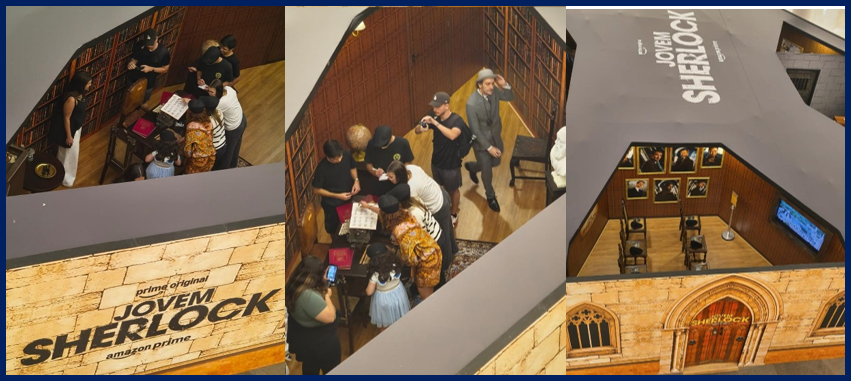
The Escape Time + Amazon Prime case with Young Sherlock Between March 13th and 22nd, Escape Time took on the challenge of bringing the universe of Young Sherlock, from Amazon Prime, into a physical, immersive, and accessible experience — inside one of the most challenging environments for activations: a shopping mall. The activation took place at Shopping Pátio Higienópolis, developed in partnership with Cake agency, with a clear objective: to create a real connection between the audience and the series' narrative.
How Immersive Experiences Can Stimulate Innovation Inside Organizations

How Immersive Experiences Can Stimulate Innovation Inside Organizations

In many companies where we implement high-impact immersive training programs, one question often comes up: How can this type of experience contribute to innovation within organizations? This is an important question because, although innovation is a common goal for most companies today, many organizations still try to foster it mainly through methodologies, processes, or tools. However, there is a fundamental point that is often overlooked: Innovation rarely comes from a single great idea or from one highly creative individual. In practice, innovation tends to emerge from environments that encourage new ways of thinking, real collaboration, and experimentation. And this is exactly where immersive experiences, such as escape games and gamified challenges, can generate tremendous value.
Corporate Training That Truly Drives Change: Escape Time’s Learning by Doing Methodology

Corporate Training That Truly Drives Change: Escape Time’s Learning by Doing Methodology

Talking about corporate training is relatively easy. But there is a question that very few programs are able to answer: Does training actually change people's behavior inside the company? In most organizations, training still follows a traditional format: presentations, theory, and concepts. The problem is that behavior does not change through information alone. Real change happens through experience. This is exactly where a new approach to team development emerges: Escape Time Training & Learning, by Escape Time Brazil.
The New NR-1 and Psychosocial Risks: What Changes for Companies and How to Turn Legal Compliance int

The New NR-1 and Psychosocial Risks: What Changes for Companies and How to Turn Legal Compliance int

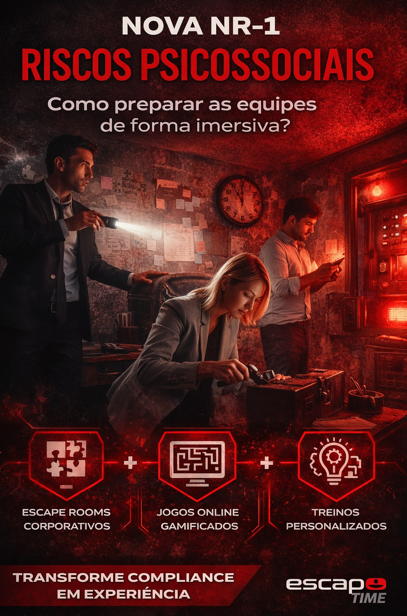
The update of NR-1 marks a turning point in people management within Brazilian organizations. From now on, psychosocial risks are formally included in the Risk Management Program (PGR), requiring companies to identify, assess, and control factors such as:
Your Team's Missing Link: Unlocking the Challenges of Corporate Collaboration

Your Team's Missing Link: Unlocking the Challenges of Corporate Collaboration

More Than a Game, a Precise Diagnosis In today's corporate landscape, agility and adaptability are crucial. However, many teams face a "missing link" that hinders the full development of their potential. This link is not an unsolvable mystery, but rather a set of behavioral and communication challenges that manifest under pressure. At Escape Time Brasil, through our Learning by Doing methodology, we closely observe these critical points and how they impact the actual performance of organizations.