
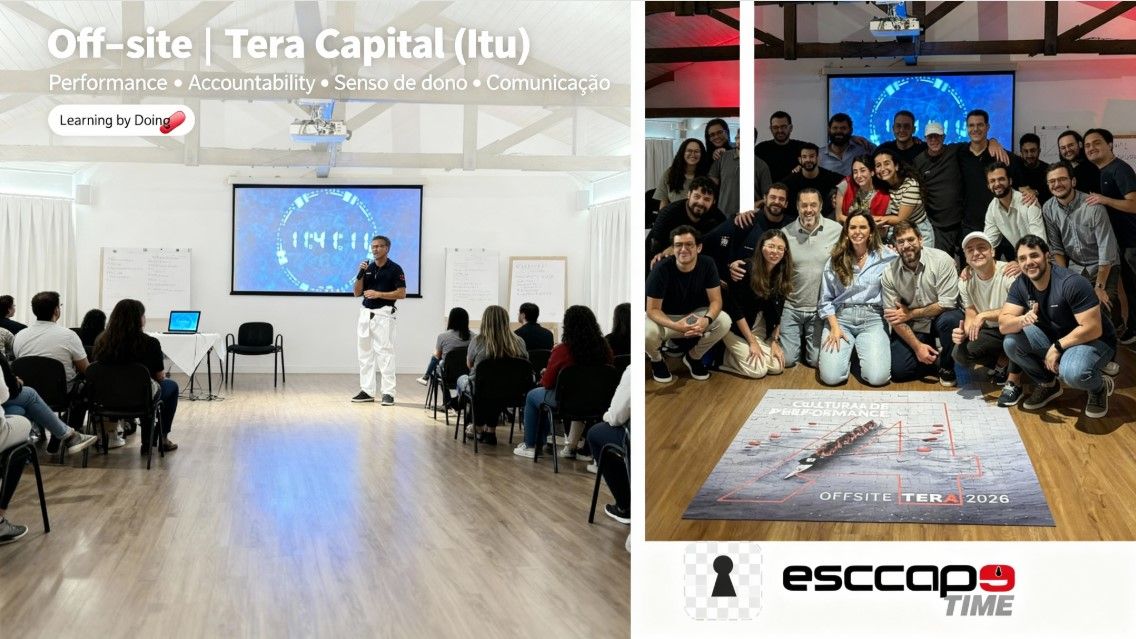
**English translation:** An off-site that turns into behavior: how @teracapital worked on performan
English translation:
Last week, we held the first off-site of the year for @teracapital, in the Itu region, with a clear goal: to create a hands-on experience that would generate alignment and strengthen the team around performance, accountability, ownership mindset, and communication.
Below, I share how we designed the experience, why it worked, and the key takeaways for any leader who wants to turn discourse into behavior.
1) The challenge: moving from “everyone agrees” to “everyone acts”
Almost every organization agrees with statements like:
“We need to be more agile.”
“We need to improve communication.”
“There’s a lack of ownership.”
“We need to raise the performance bar.”
The problem is that agreement doesn’t change routines.
Routines change when:
the team experiences the consequences (good and bad) of their choices;
communication patterns become visible;
responsibility stops being abstract and becomes a practical decision;
the team collectively realizes what accelerates or blocks delivery.
That was exactly the premise of our design: to create a safe, intense, and collaborative environment where the behaviors required for high performance would emerge naturally.
2) The approach: Learning by Doing
We chose the Learning by Doing methodology because it creates a type of learning that rarely happens through lectures alone.
Instead of talking about accountability, the team has to practice accountability.
Instead of discussing communication, the team has to communicate in order to move forward.
Instead of defining ownership, each person has to take responsibility for what’s under their scope so the collective can win.
This approach is especially powerful for teams that are already technically strong but want to improve coordination, pace, alignment, and collective decision-making.
3) The dynamic: “escape time” style, with a collective final delivery
At the center of the experience was an escape-time-style dynamic: a journey of challenges where the final delivery only happens when the group truly operates as a team.
In practice, this creates a behavioral laboratory:
Who leads what (and how)?
Does the team clearly distribute roles, or does everyone try to do everything?
Are decisions centralized, or does the team create responsible autonomy?
Does the team share context or hoard information?
When something goes wrong, is the reaction to look for blame or to look for solutions?
The most important point: the design forces real collaboration. There is no “individual winner.” Either the team evolves together, or the delivery doesn’t happen.
4) What we observe (and why this is so valuable)
Well-designed dynamics work like an X-ray of how the team functions, without exposing anyone.
Some patterns that usually emerge—and are extremely helpful for diagnosis and evolution—include:
Clarity vs. noise: Does the team align on a plan and criteria, or start executing without alignment?
Prioritization: Does the team differentiate urgency from importance, or react to the loudest stimulus?
Ownership of the problem: When an obstacle appears, does someone take responsibility, or does it “hang in the air”?
Communication: Are messages short, clear, and confirmed, or long, indirect, and full of assumptions?
Coordination: Does the group operate sequentially (dependent) or in parallel (smart), gaining speed?
This type of observation is gold for leaders and People/HR teams, because it brings concrete examples of what needs to be adjusted in daily work.
5) The debriefing: the bridge between experience and routine
The dynamic alone is engaging. But what turns it into results is a structured debriefing.
After the final delivery, we led a session to connect the experience with the team’s day-to-day reality:
What worked, and why?
What slowed us down, and why?
Which decisions generated waste (time, energy, rework)?
Which behaviors accelerated performance?
What do we need to start doing, stop doing, and continue doing?
This is the moment when the experience becomes shared language, agreements, and next steps.
Without debriefing, it’s just “that was fun.”
With debriefing, it becomes “starting tomorrow, we’re going to operate differently.”
6) Key learnings from the case (applicable to any company)
Here are learnings that frequently emerge in highly effective off-sites and that strongly connected with what we saw in this one:
1. Performance is a system, not an individual effort
When teams improve alignment, roles, decisions, and communication, performance increases without relying on “heroes.”
2. Accountability is clarity + commitment + follow-up
It’s not about pressure. It’s about defining owners, agreeing on criteria, and following up in a mature way.
3. Ownership emerges when there is autonomy with boundaries
Autonomy without agreements creates chaos. Agreements without autonomy create slowness. Balance builds strong teams.
4. Communication improves when it becomes an execution tool
The team doesn’t “talk more.” It talks better: with purpose, conciseness, validation, and timing.
5. The best off-site ends with a simple plan
A few well-chosen decisions that fit into the real agenda and change Monday morning.
7) Who is this type of off-site ideal for?
This format is especially effective for:
growing teams (recent hires, area expansion, new leadership);
companies that want to raise the performance bar without losing culture;
leaders seeking more autonomy and less top-down dependency;
organizations aiming to strengthen alignment and execution rituals.
8) Want to bring this experience to your company?
If you’re planning an off-site, a leadership meeting, a team integration, or a strategic alignment moment, we can design a tailored experience with:
a clear objective (what behavior needs to change);
hands-on dynamics (Learning by Doing);
structured debriefing;
an application plan (rituals, agreements, next steps).
Get in touch to talk and build a proposal:
Send a message with “OFFSITE” and share: team size, main challenge, and desired timing.
Or, if you prefer, ask for “AGENDA” and we’ll share a sample agenda for you to review.