
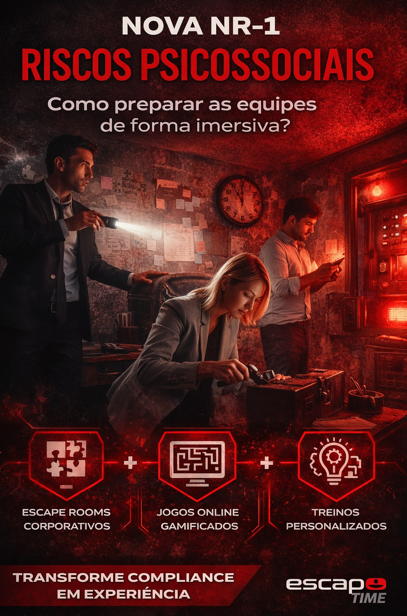
The New NR-1 and Psychosocial Risks: What Changes for Companies and How to Turn Legal Compliance int
Occupational stress
-
Workplace harassment and interpersonal conflicts
-
Work overload
-
Excessive performance pressure
-
Communication failures
-
Toxic organizational environments
More than a documentation update, this represents a structural shift in how companies must view the work environment.
What Are Psychosocial Risks in Practice?
Psychosocial risks are factors related to work organization, interpersonal relationships, and company culture that can directly impact employees’ mental, emotional, and social well-being.
They are not as visible as physical hazards.
But their effects are profound:
-
Increased burnout-related leave
-
Growth in labor lawsuits
-
Decreased productivity
-
High turnover rates
-
Disengagement
-
Employer brand damage
The new NR-1 makes it clear: ignoring these factors is no longer an option.
Compliance Is Not Just Documentation — It’s Culture
Many companies may fall into the trap of treating NR-1 as a bureaucratic requirement: updating risk inventories, adding topics to the PGR, and recording formal training sessions.
But the most important question is:
Does traditional training really change behavior?
Informative slides and lecture-style presentations rarely transform culture.
Psychosocial risks are linked to behavior, leadership, communication, and decision-making under pressure. And behavior does not change through theory alone — it changes through experience.
Experiential Learning as a Strategic Tool
This is where an innovative approach comes in: immersive learning.
Experiences such as corporate escape games, simulations, and gamified dynamics create controlled environments where teams experience:
-
Time pressure
-
The need for collaboration
-
Conflict management
-
Assertive communication
-
Situational leadership
-
Strategic decision-making
By living through these situations, participants reveal real behavioral patterns — and it is during structured debriefing that true learning happens.
This is not entertainment.
This is applied behavioral development.
How Escape Time Supports Companies in Adapting to the New NR-1
Escape Time develops immersive solutions that can be integrated into corporate training and development programs, supporting companies in the preventive management of psychosocial risks.
???? In-Person Corporate Escape Rooms
Immersive simulations that place teams in challenging scenarios, fostering:
-
Collaboration under pressure
-
Clear communication
-
Emotional management
-
Problem-solving
-
Collective intelligence
After the experience, we conduct a strategic debriefing connecting observed behaviors to the corporate reality.
???? Online Gamified Experiences
Ideal solutions for hybrid or distributed teams, allowing organizations to work on:
-
Remote collaboration
-
Virtual leadership
-
Engagement
-
Organizational culture
With measurable performance tracking and structured insights.
???? Customized Programs
We develop narratives and challenges aligned with each company’s culture and values, connecting organizational principles to desired behaviors.
We transform compliance into experience.
From Legal Obligation to Competitive Advantage
Companies that treat NR-1 solely as a legal risk will always be reacting.
Companies that see psychosocial risk management as a strategic initiative will be building:
-
Psychologically safe workplaces
-
More engaged teams
-
More conscious leadership
-
Stronger organizational culture
-
A powerful employer brand
The new NR-1 is not just a regulation.
It is an invitation to evolve.
The Future of Corporate Training
The corporate world has changed.
Work relationships have changed.
People’s expectations have changed.
Training today requires engagement, emotion, reflection, and practice.
The question remains:
Will your company simply comply with the regulation — or use this moment to differentiate itself?
If you want to transform legal compliance into a human development strategy, Escape Time can help.