
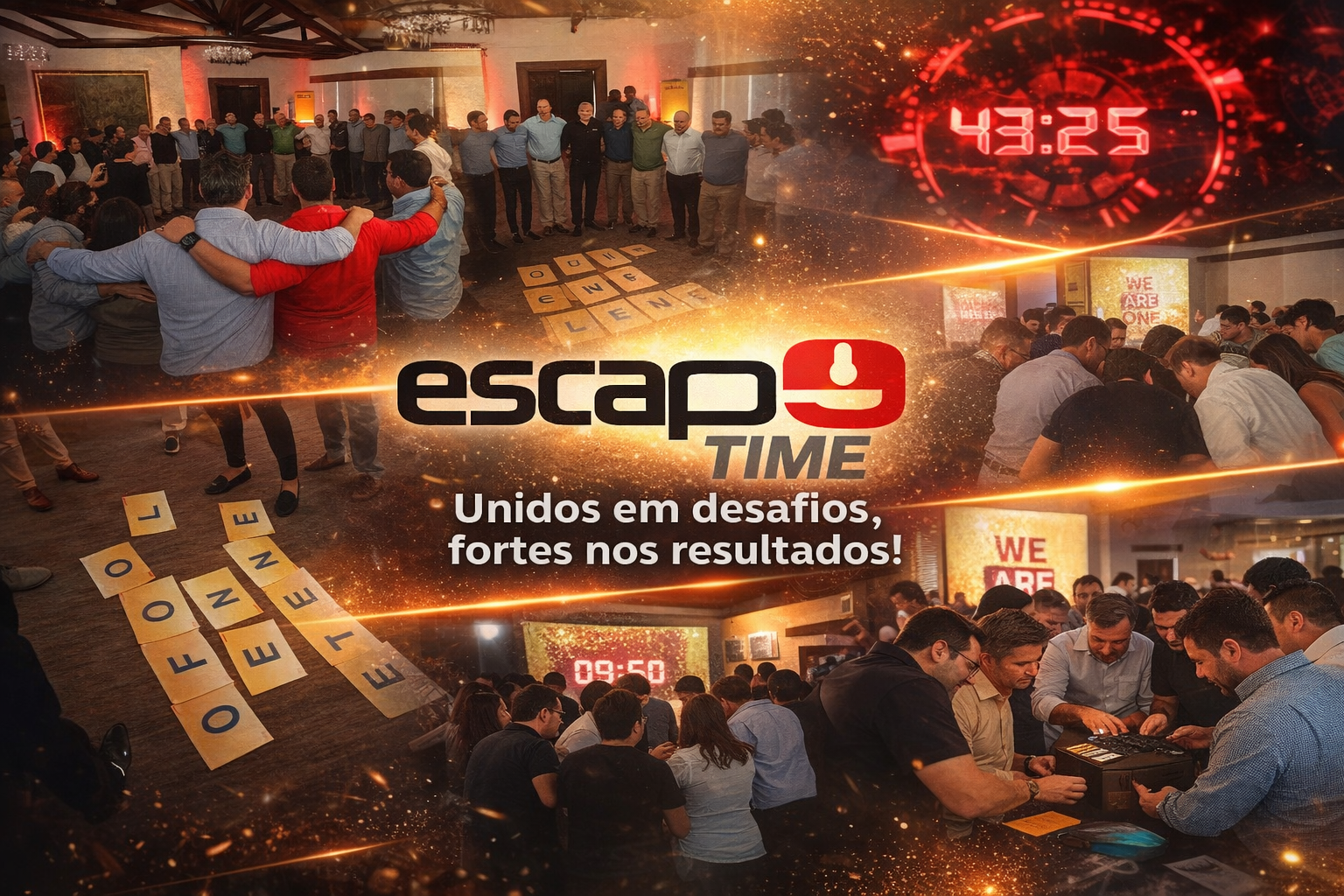
New Year Kick-off: 3 Formats That Create Real Alignment (Not Just Speeches)
At Escape Time, after years working with kick-offs, corporate conventions, and off-sites, we’ve seen a clear pattern: goals only turn into action when they become conversation, productive conflict, and group decision-making. And that’s exactly where immersive, gamified formats make a difference.
Below, we share three kick-off formats that greatly increase the chances of creating real alignment—not just another “nice” event.
1. Alignment through dilemmas, not just messages
In many kick-offs, strategy is presented as a set of messages: “customer focus,” “sustainable growth,” “innovation with responsibility.” That’s necessary, but it’s not enough.
What truly builds alignment is working through concrete dilemmas, such as:
– Grow fast or protect margins?
– Centralize decisions or empower the front line?
– Focus on current customers or invest in new segments?
When a team must make decisions under constraints, strategy stops being a catchy phrase and becomes a decision-making filter. In a well-run dynamic, people:
– Experience real business trade-offs in practice.
– Notice where different interpretations exist around the same objective.
– Build clearer agreements on “how we will decide when this dilemma shows up for real.”
That’s exactly what a strong corporate escape game can simulate: situations where the group must choose paths, prioritize resources, and decide what to sacrifice—under time pressure and with visible consequences inside the game.
2. Alignment through cross-functional interdependence
Another common mistake is treating the kick-off as a sequence of departmental presentations: each team shows its numbers, plans, and initiatives. Again—necessary, but not sufficient.
In reality, goals are almost never owned by just one area. Sales depends on Operations, which depends on Technology, which depends on Business decisions—and so on. If the event format doesn’t force interdependence, each area leaves with its own plan, but without clarity on how to “play together.”
In experiences we design for clients, it works especially well when:
– The challenge requires one team to progress only if another progresses too.
– Information is distributed across groups, forcing exchange and collaboration.
– Time is limited, revealing communication bottlenecks and misaligned priorities.
In practice, this can happen through:
– Immersive plenary sessions with a single mission for 30, 100, or even 1,000 people, where one group’s decisions impact everyone else’s progress.
– Squad-based rounds, where cross-functional teams must co-create solutions to the same business challenge.
When the dynamic mirrors real operational interdependence, alignment stops being talk and becomes lived experience: people feel what it means that “without team X, we can’t deliver Y.”
3. Alignment through behavioral evidence
“We need to collaborate more,” “we need clearer communication,” “leadership must be closer to the team.” Statements like these show up in almost every kick-off.
The challenge is moving from intentions to evidence: what actually happens when we’re under pressure, working with incomplete information, or facing an unexpected problem?
That’s why one of the biggest advantages of an immersive format is that it allows teams to:
– Observe behavior in action: who steps into leadership, who listens, who monopolizes the conversation, who connects scattered dots.
– Gather concrete examples for the debrief: “in that moment, we decided without involving team X,” “information got stuck in one group,” “we lost time debating details without watching the clock.”
– Facilitate a mature, non-judgmental reflection, because the “test environment” is the game, not daily work—yet the learning transfers directly.
When a group sees itself in action, the conversation about culture, leadership, and collaboration levels up: instead of loose opinions, you discuss observable facts.
How a plenary escape-game format supports all of this
A corporate escape-game plenary is a format that integrates these three types of alignment:
– It puts the group in front of business-relevant dilemmas, translated into game challenges.
– It structures the challenge so functions and teams need each other to move forward.
– It creates a safe environment where behaviors can be observed, discussed, and recalibrated through a structured debrief.
From the perspective of the person organizing the kick-off, the main benefits are:
– Real engagement: people participate actively, not just watch.
– Strong use of time: in 60–120 minutes, you can generate rich inputs for strategic conversations throughout the event.
– Coherence with the message: if you talk about ownership, collaboration, and customer focus, the event format must invite those behaviors—not just the slide content.
Practical tips for designing your next kick-off
If you’re planning your annual kick-off or early-year off-site, a few questions can help turn the event into a space for real alignment:
1. What needs to be decided together here, not just communicated?
2. Which real business dilemmas could be simulated in a dynamic?
3. Where do teams “clash” most today? How could an interdependence challenge surface this constructively?
4. What behaviors do we want to observe and reinforce (or adjust) for the next cycle?
These answers—more than the “theme” of the event itself—are often the best briefing for any immersive experience.
Where Escape Time fits into this conversation
At Escape Time, this is exactly our focus: turning trainings, kick-offs, and off-sites into immersive experiences that develop teams through practice, emotion, and group decision-making.
We deliver:
– Immersive escape-game plenaries for 30 to 1,000 people.
– Squad-based dynamics aligned to specific functional challenges (Sales, CS, Operations, etc.).
– On-site formats (in-company, hotels, venues) as well as hybrid/online formats for distributed teams.
– Observation and structured debriefs to turn what happened in the game into concrete commitments for the year.
If you’re planning a kick-off or early-year off-site and want to explore a format that goes beyond a “motivational event,” it’s worth taking the next step.
Just send us: city, target date, approximate number of participants, and the main objective of the session. From there, we can suggest a few dynamic formats that fit your reality and your eam’s goals—always focused on real alignment, not just talk.