
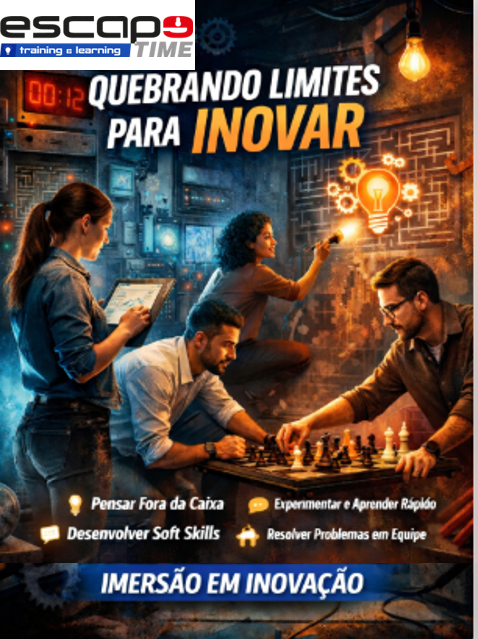
How Immersive Experiences Can Stimulate Innovation Inside Organizations
Taking People Out of Autopilot
Much of corporate work happens within routines, processes, and familiar structures. While this brings efficiency, it can also limit how people think and solve problems.
When teams are placed inside an immersive challenge environment, something interesting happens.
Participants must leave their “autopilot mode” and activate new skills to deal with unexpected situations.
They begin to:
-
interpret clues
-
connect seemingly unrelated information
-
deal with time pressure
-
test hypotheses quickly
-
collaborate intensely with the team
This type of experience creates a safe environment to experiment with new ways of thinking.
And that is exactly what innovative environments require.
Soft Skills: The Real Engine of Innovation
Another important point is that innovation rarely happens in isolation.
It depends on people working together.
During immersive challenges, several key competencies naturally emerge:
Effective communication
Players must quickly share discoveries and explain their reasoning to the group.
Genuine collaboration
Solutions usually arise from combining different perspectives.
Active listening
Ideas come from all directions — and sometimes the decisive clue comes from someone who had been silent until that moment.
Decision-making under pressure
Limited time forces teams to prioritize and act quickly.
Adaptability
When a hypothesis fails, the group must shift strategies.
These are precisely the soft skills most associated with innovative environments inside organizations.
A Laboratory for Experimentation
One essential characteristic of innovation is the ability to test, fail, adjust, and try again.
In traditional corporate environments, failure is often perceived negatively. This creates cultures where people hesitate to take risks.
Immersive experiences completely change this dynamic.
Inside a game:
-
experimentation is expected
-
mistakes are part of the process
-
rapid learning is essential
This transforms the activity into a true laboratory of organizational behavior, where teams can practice exactly the behaviors needed to innovate.
The Power of Collective Intelligence
A phenomenon that frequently appears during immersive challenges is collective intelligence.
In many cases, the solution to a puzzle does not exist in the mind of a single person.
Instead, it emerges when participants:
-
notice different details
-
interpret clues in different ways
-
connect pieces of information others may have missed
The result is a natural process of co-creating solutions.
And this is one of the most important pillars of innovation in modern organizations.
Training Teams to Solve Complex Problems
The corporate world is increasingly defined by:
-
ambiguity
-
rapid change
-
problems with no obvious solutions
Immersive challenges recreate exactly these types of scenarios.
Teams must deal with:
-
incomplete information
-
time pressure
-
multiple possible paths
As a result, they develop key capabilities such as:
-
creative reasoning
-
systems thinking
-
adaptability
These competencies are becoming increasingly valuable for organizations that want to remain competitive.
Much More Than Entertainment
When well designed, immersive experiences go far beyond being just fun activities.
They become strategic tools for human development.
More than simply solving puzzles, participants practice:
-
new ways of thinking
-
new ways of collaborating
-
new ways of solving problems
This is exactly the approach we aim to deliver through Escape Time Trainer & Learning programs.
We create environments where teams can experiment, learn, and develop the skills needed for the future of work.
In the End, Innovation Is About People
Many companies invest heavily in technology, processes, and methodologies to drive innovation.
But one factor remains decisive:
how people think and work together.
Innovation is not only about having good ideas.
It is about creating environments where people can explore possibilities, collaborate, and transform challenges into solutions.
And immersive experiences can be one of the most powerful ways to train exactly that.